2026 Family Law: Navigating Divorce and Separation in Ontario
“Navigating divorce in Ontario isn’t just about paperwork—it’s trying to keep your life together while everything changes. The province’s family law system keeps evolving, and the 2025–2026 updates matter: revised child support tables (effective October 1, 2025), expanded digital filings, and stronger enforcement of family arbitration awards. The goal is to make the process clearer, faster, and more practical for real families.”
Let’s cut through the legal fog and unpack what this means for you.
Understanding Divorce and Separation
Divorce
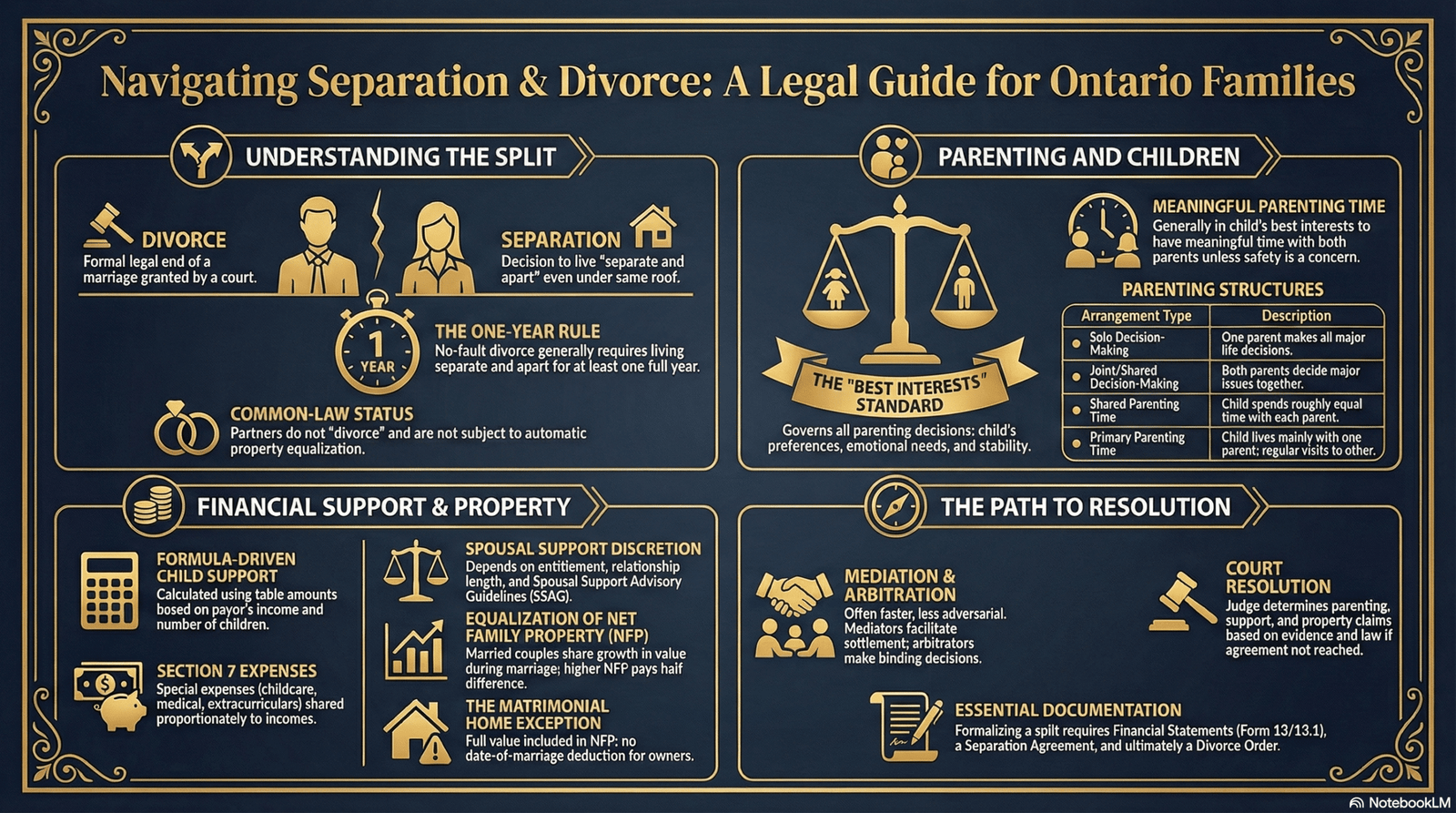
Divorce ends a legal marriage under Canada’s Divorce Act. Most people qualify after living “separate and apart” for at least one year in a no-fault divorce—and yes, you can’t remarry until the court issues a divorce judgment.
Separation
Separation happens when partners stop living together as a couple, even under the same roof. It triggers questions of support, parenting, and property under Ontario’s Family Law Act (FLA) and Children’s Law Reform Act (CLRA)—and for married parents, the Divorce Act still applies to parenting issues.
Common-law partnerships
Common-law partners don’t automatically share property like married couples. There’s no “equalization” of net family property. Instead, claims rely on equitable principles—like unjust enrichment or constructive trust—which can be complex and evidence-driven.
2026 note on polyamory
There’s growing discussion around support claims in polyamorous relationships, sometimes after three years of cohabitation. This remains a developing area—get legal advice and verify carefully.
Myths That Derail People
- Separation itself doesn’t end property rights.
- A separation agreement isn’t a divorce—only a court judgment is.
- Properly conducted family arbitration awards can be enforced like court orders.
- Support obligations continue until changed by a new order or agreement.
Key Family Law Issues in Ontario (2026)
1. Parenting and Decision-Making
Ontario now uses modern, child-focused language:
- Decision-making responsibility (formerly “custody”)
- Parenting time (formerly “access”)
Courts aim for clarity, early disclosure, and cooperative resolution through ADR (Alternative Dispute Resolution). There’s also stronger enforcement when parenting orders aren’t followed—because children need stability, not ongoing conflict.
2. Child Support Updates
Big update: Child support tables under the Federal Child Support Guidelines changed on October 1, 2025. Using outdated numbers could affect your payments.
Section 7 expenses—like childcare, uninsured medical costs, extracurriculars, and educational needs—are shared in proportion to each parent’s income. Always document and focus on what’s reasonable for your child.
FRO reminder: The Family Responsibility Office enforces support orders (through measures like wage garnishments), but only a court or valid agreement can change them. If your situation shifts, go through official channels to vary it.
3. Spousal Support
Support depends on factors like roles during the relationship, economic disadvantage, length, and ability to pay. Courts rely on the Spousal Support Advisory Guidelines (SSAG) for structure.
2026 update: Family arbitration awards about spousal support can now be enforceable like court orders—so treat arbitration as a formal, legally binding process.
4. Property Division & Taxes
Equalization shares the increase in each spouse’s net worth during the marriage.
Matrimonial home alert: You can’t deduct the home’s marriage-date value when calculating equalization. It’s often the biggest surprise in property division.
Tax basics:
- Spousal support is generally taxable for recipients and deductible for payors.
- Child support is neither taxable nor deductible.
Resolving Your Case
Digital Filing (Justice Services Online)
You can now file many family court documents online across Ontario. This reduces delays and travel headaches—important when life already feels chaotic.
Mediation and Arbitration
Mediation helps with guided negotiation. Arbitration provides a binding decision if done properly. The goal isn’t “being nice”—it’s being efficient and protecting your energy, your finances, and your kids.
Mandatory Information Program (MIP)
In contested cases, both parties usually attend a MIP within 45 days of filing. You’ll learn how the process works, how conflict affects children, and what settlement options exist before diving into court battles.
Supporting Yourself and Your Children
For You
Recovery takes time. Focus on:
- Therapy (even short-term helps)
- Healthy routines (sleep, meals, exercise)
- A support network that tells you the truth
For Your Children
Prioritize reducing conflict, not “winning.” Kids do best with:
- Predictable routines
- Reassurance that it’s not their fault
- Freedom from adult disputes
You don’t have to pretend everything’s fine—you just need to keep it safe.
Ontario & Canadian Resources
Legal and Government
- Superior Court of Justice (Online Filing)
- Family Responsibility Office (FRO)
- Law Society of Ontario
- Legal Aid Ontario
Dispute Resolution
Mental Health
Legal Disclaimer
This article offers general information only—it’s not legal advice. Family law changes frequently, and every situation is unique. Seek qualified professional advice, especially given the October 2025 child support updates, expanded digital court access, and arbitration enforcement changes shaping Ontario family law in 2026.
About the Author
Written and reviewed by Danielle Pike, Founder of CustodyBuddy.com — self-represented litigant, Ontario family law advocate, and legally blind mother of two navigating high-conflict co-parenting in the Ontario court system. Last reviewed: April 2026.
Need to document an incident for court?
The CustodyBuddy Incident Report Generator guides you step by step — Canadian legal classifications, automatic timestamps, and a court-ready export in under 3 minutes.
Legal disclaimer: This article is for educational purposes only and does not constitute legal advice. For advice specific to your situation, consult a qualified Ontario family lawyer or visit CLEO’s Steps to Justice.