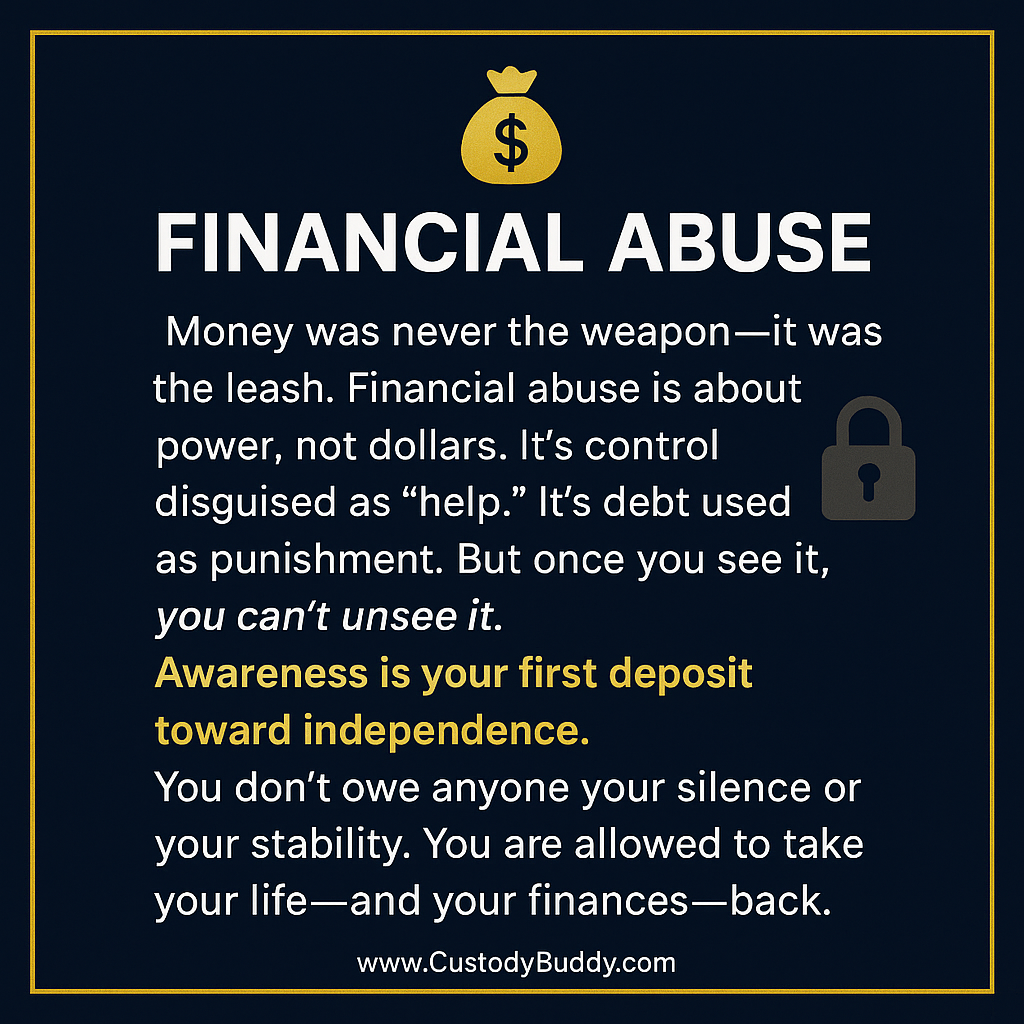
Money Was Never the Weapon—It Was the Leash
If you’ve ever felt like your wallet had a GPS tracker—and your ex was the one watching the blip on the screen—congrats, you’re probably dealing with financial abuse. It’s sneaky, it’s suffocating, and it shows up dressed as “help” more often than not.
Let’s get one thing straight: when someone uses money to control you instead of co-parent with you, that’s not just bad vibes. That’s abuse—with a capital “nope.” And spotting it? That’s your new superpower.
What in the World Is Financial Abuse?
It’s not just “being bad with money,” and it’s sure as heck not something you can fix with a better budget app. Financial abuse is when someone uses cash—or denies it—as a control mechanism. Think less spreadsheet, more power play.
How It Shows Up
- They shut down your access to bank accounts “for your protection.” (Yeah, right.)
- You have to track every cent like you’re on a game show, but they’re buying $300 golf bags—no drama.
- They “accidentally” forget to pitch in for groceries or school shoes. Again.
- Your credit score is in the ICU, thanks to a joint account they maxed out and ghosted.
These aren’t quirky “relationship hiccups.” According to the National Network to End Domestic Violence, a staggering 99% of domestic abuse cases include financial control. That’s not an oopsie—it’s a pattern.
The Emotional Price of Their Power Games
Let’s toss the calculator for a minute. Because this goes way beyond the bank balance. Financial abuse chips away at your confidence. One day you’re making smart parenting moves. The next? You’re being told you’re manipulative, lazy, or out of touch—for daring to ask for kids’ activity fees.
If your gut’s been whispering, “Hmm… this feels off,” you’re not crazy. You’re correct.
Behind the Curtain: The Puppet Strings of Control
“I’m Just Trying to Help”—Sure, Jan
Oh, the classics. “You’ve got enough on your plate—I’ll handle the money.” Feels generous, right? Until one day every major financial decision is out of your hands, and they’re calling that “support.” Spoiler alert: that’s not help. That’s control wrapped in a gift bow.
Things can get extra spicy during custody talks. Maybe they offer to cover hockey, ballet, and orthodontics—on one condition: no child support filings. Or they threaten to skip out on the mortgage if you challenge their parenting plan. Peace offerings? More like bribes in sweatpants.
Debt as a Designer Handbag… with Shackles
This one’s extra cruel. They may open credit cards in your name, ring up charges faster than a toddler in a toy store, and bounce—leaving you with late fees and a headache. Or maybe there’s a joint loan, but you’re the only one getting the calls from collections.
This isn’t “oops.” It’s economic sabotage. And it can haunt you long after the house is divided and the custody ruling is stamped.
Why They Want You Stuck—and Struggling
The less freedom you have, the more control they gain. If you’re drowning in rent panic or don’t think you can afford a lawyer? Jackpot—for them. But being overextended isn’t a personal failure. It’s a tactic, and it’s working exactly the way they want it to.
Wait… Is This Financial Abuse?
The Power of “Wait a Sec…”
You don’t have to be completely broke to be experiencing financial abuse. It’s not about income—it’s about access. Control. And whether you’re being sidelined in decisions that involve joint responsibilities (like…oh, parenting).
Red Flags That Deserve Side-Eye
- You’re “discouraged” from having a job—because it’s “better for the kids.”
- They hold all the financial cards (and probably lock them in their sock drawer).
- You get the silent treatment—or a surprise bill—when you challenge them.
- You were pressured into signing financial documents you didn’t understand.
- Money convos always end in guilt trips, gaslighting, or legal threats.
Reality Check: Ask Yourself This
- Do I feel secure when it comes to our financial arrangement?
- Am I treated like an equal when making financial decisions—or made to feel “less than”?
- Have I held my tongue just to keep money flowing—or avoid a fight?
If your brain just screamed “yes” to any of these, then ding ding ding—you’ve got some unpacking to do. But don’t worry, this ride ends in freedom. Not frustration.
Plot Twist: You Can Take the Wheel
Stability Isn’t a Favor—they Don’t Get to Lease Your Peace
It’s tempting to keep the surface calm. For the kids. For the mortgage. For the in-laws on Facebook. (Yikes.) But if quiet comes at the cost of your power and peace, it’s not calm—it’s coercion.
Small Moves, Supernova Impact
- Build your squad. Friends, advocates, legal pros—you need people (not just your group chat) in your corner.
- Level up financially. Apps like YNAB can give you serious confidence. Platforms like HerFinance break it down with zero judgment.
- Call in the experts. Family law attorneys, financial abuse recovery coaches, and trauma-aware therapists can help you build a legit plan.
You don’t need to sprint—you just need to start. One tiny “no.” One record of a conversation. One switched-off auto-payment. One step toward sovereignty.
Set (Savage) Boundaries Like a Boss
Document everything. Start with grocery receipts if that’s all you’ve got. Set expectations in writing. Push back on one financially-controlling demand—even gently. Every boundary you set is a brick in the foundation of your freedom palace.
Need help setting those new lines in the sand? Grab a script or template from the Resource Library and let the boundary-setting begin.
For the Friend Who’s in This Mess
Support = Superpower
If someone in your world is tangled in this mess, forget the old “Why don’t they just leave?” line. Offer safety. Offer your ears. And maybe send them this article—for a not-at-all-subtle nudge with love.
Sometimes, just hearing “You’re not imagining this” chips the first crack in the armor.
You’re Not the Only One—But You Are the One in Charge Now
So many parents (especially moms, but hey—shoutout to all caregivers navigating co-parenting chaos) have been told this isn’t “real abuse.” But real harm doesn’t need a bruise to leave a mark.
Whether you whisper your truth into a journal or yell it into a pillow (highly recommend), naming it is a major deal. And you don’t have to figure everything out alone.
Continue Your Family Law Journey
Navigating financial abuse during custody requires trusted guidance and practical tools. These resources connect you to real-world support, from emotional resilience to legal pathways, so you can reclaim autonomy with informed steps.
- REES (Resilience, Education, Empowerment & Support)
- Egale Canada
- West Coast LEAF
- Resource Library
- CustodyBuddy
One Last Thought (for Now)
Financial abuse is real, and it’s everywhere—but so is resistance. So is knowledge. And so is your comeback story, unfolding one bold, bank-balance-reclaiming step at a time.
You are not too sensitive. You are not overreacting. You are the storm they didn’t expect—and you’re just getting started.
Know someone who needs this? Share it. Let’s call out this kind of control for what it is—and walk away cashing checks written in freedom.
Disclaimer
This content is for coaching and educational purposes only. It is not a substitute for individualized legal advice. Always consult a qualified family law professional regarding your unique situation, especially if you are navigating financial abuse or custody-related concerns.
Recommended Resources
These books have helped many parents navigate similar challenges. As an Amazon Associate, I earn from qualifying purchases.
The Gaslighting Recovery Workbook
by Amy Marleans
This workbook provides practical tools to help survivors of gaslighting navigate their emotions and regain their confidence in high-conflict situations.
Breaking Free from Narcissistic Abuse
by Gina Harkins
This book offers insights and strategies for escaping and healing from narcissistic relationships, especially relevant for co-parents in toxic dynamics.
Dear Parent: The Kind Guide to Stress-Free Co-Parenting
by Kerry McGowan
Filled with practical communication tips and strategies, this book empowers parents to navigate co-parenting challenges with understanding and compassion.
About the Author
Written and reviewed by Danielle Pike, Founder of CustodyBuddy.com — self-represented litigant, Ontario family law advocate, and legally blind mother of two navigating high-conflict co-parenting in the Ontario court system. Last reviewed: April 2026.
Need to document an incident for court?
The CustodyBuddy Incident Report Generator guides you step by step — Canadian legal classifications, automatic timestamps, and a court-ready export in under 3 minutes.
Legal disclaimer: This article is for educational purposes only and does not constitute legal advice. For advice specific to your situation, consult a qualified Ontario family lawyer or visit CLEO’s Steps to Justice.
![Quebec's New Parental Union Regime for Common-Law Parents (Effective June 30, 2025): This law automatically creates a shared "parental union patrimony" for common-law couples with children born after June 30, 2025, mandating equal division of family residence, furniture, and vehicles upon separation, plus court protections allowing the custodial parent temporary use of the home—impacting fathers' asset rights and custody stability in non-marital separations.[1]](https://blog.custodybuddy.com/wp-content/uploads/2026/01/2026-01-14T110219.001Z-output1.jpeg)