Boundaries Aren’t Selfish – They’re Sacred (And Totally Badass)
Let’s clear something up real quick: setting boundaries doesn’t make you a villain in some low-budget daytime drama. It makes you the director, producer, and lead star of your own feel-good comeback story. 🎬✨
If you’re dealing with a high-conflict custody situation or a toxic ex who thinks emotional chaos is a group sport—this one’s for you. Mixed messages like “Do it for the kids” or “You’re just being difficult” often disguise serious disrespect. So, let’s name it, claim it, and build walls high enough to keep the drama out (and the peace in).
What Are Boundaries (and Why Do They Deserve a Standing Ovation)?
Think of boundaries as your personal VIP ropes—defining who gets backstage access to your mind, heart, and calendar.
- Emotional boundaries: Protect your feelings like your future depends on it. (Spoiler alert: it does!)
- Physical boundaries: These say, “This is my space. Please don’t treat it like Walmart on Black Friday.”
- Digital boundaries: Just because someone has a phone doesn’t mean they have 24/7 access to you.
- Psychological boundaries: Holding onto your thoughts, values, and sanity like a pro.
Boundaries do one magical thing: they preserve your mental health. And in a high-conflict dynamic, that makes them less like guidelines and more like survival gear.
The Myth of “Selfish Boundaries”
Ever heard “You’re making this harder than it needs to be”? Sure. That’s code for “You’re refusing to be a doormat!” 👏
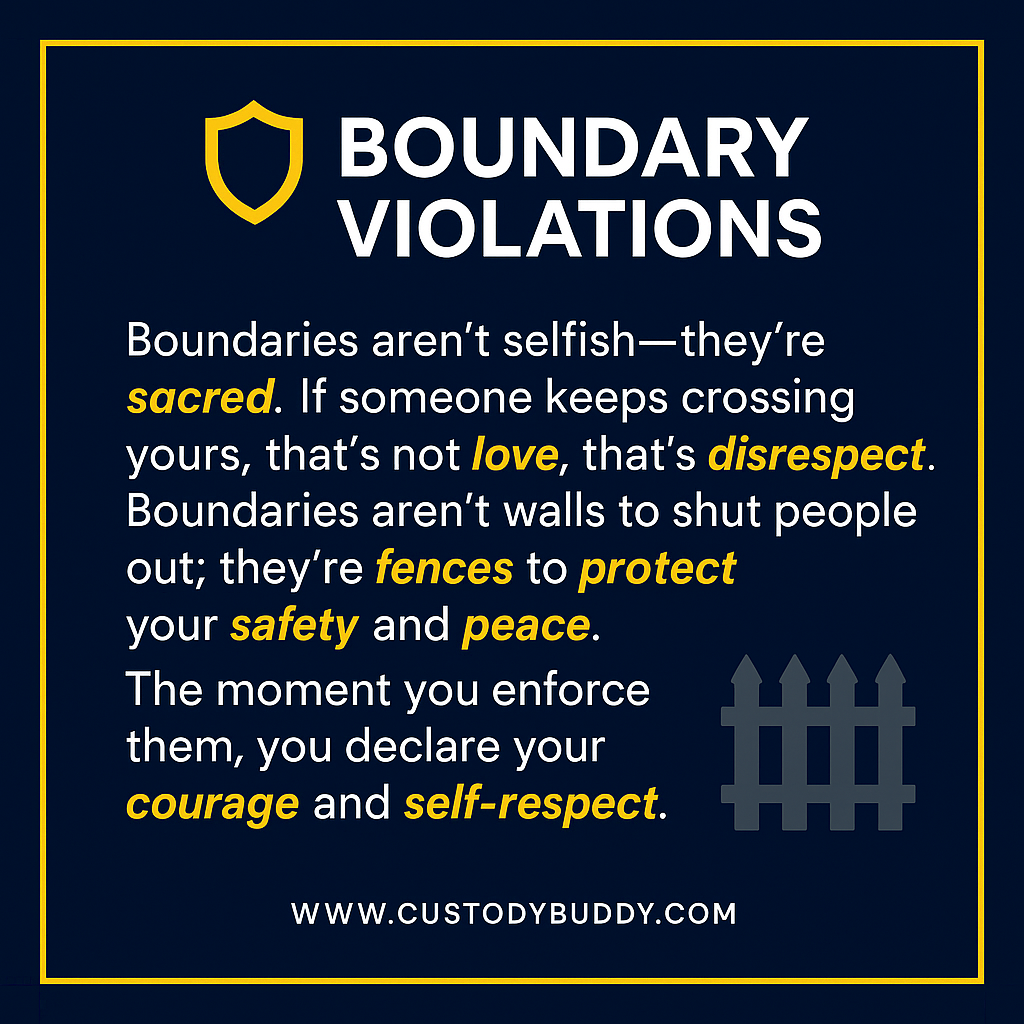
Look. Boundaries aren’t about cutting people off. They’re about cutting off behavior that robs you of your peace. Big difference.
Let’s ditch that inner guilt-monster (it’s not cute) and remember what Dr. Brené Brown said: “Daring to set boundaries is about having the courage to love ourselves, even when we risk disappointing others.” So go ahead—disappoint anyone who benefits from your silence. That’s not cruelty. That’s self-respect dressed in confidence.
When Boundaries Get Steamrolled (A.K.A. Emotional Bulldozing)
If you’re constantly fielding unwanted texts, surprise visits, or bait-filled emails, you’re not paranoid—you’re being poked where it hurts. And that’s not miscommunication. That’s chronic overstepping.
- The ex who shows up uninvited “just to see the kids”? Boundary buster.
- The 37 back-to-back text messages? Emotional spam.
- The calendar chaos that ruins your workday? Weaponized inconsistency.
The result? Burnout. Resentment. And let’s not forget that ever-present whisper of self-doubt: “Am I overreacting?” Spoiler alert: You’re not.
Love vs. Control: What’s Really Going On?
Here’s a plot twist for the ages: real love respects your ‘no’.
It doesn’t show up at 10 PM or guilt-trip you over school pickups. And it certainly doesn’t dress up toxic behavior in phrases like “I just care so much.”
If someone can’t respect a simple boundary like, “Please don’t text me after 6 PM,” their love might be loud—but it’s not healthy. Because love without mutual respect? That’s just manipulation with lipstick on it.
How to Start Drawing Lines (That People Can Actually See)
If you’re new to setting boundaries, welcome to your origin story. 🎉 Here’s your starter pack:
- Spot the signal: If someone leaves you feeling drained or aggravated, a boundary might be needed.
- Be specific: “I feel uncomfortable” becomes “I will only communicate through email regarding the kids.”
- Use “I” statements: Because “You’re a raging stress-case” will go over like a lead balloon. Try: “I feel anxious when our agreements aren’t followed.”
The goal isn’t to micromanage anyone else’s behavior—it’s to clearly define what you will and will not allow. Think of it as the emotional equivalent of putting pants on before leaving the house: basic, respectful, and not up for debate.
Enforcing Boundaries Without Backing Down (Cue Rocky Theme)
You’ve said your boundary. *mic drop* But now comes the hard part: sticking to it.
Yep, this part can feel icky—especially if you’re used to fawning, fixing, or people-pleasing. But you can’t shrink your boundaries to keep someone else comfortable and expect to thrive. Not how it works.
- Start small: Don’t respond to argumentative texts. Schedule drop-offs at neutral places. Let silence say what needs saying.
- Brace for backlash: People who thrived off your compliance won’t send thank-you cards. But they’ll get the message.
- Stick with it: Your first “no” is the scariest. The second? Liberating. By the fifth? Legend status.
Remember: your kids learn from how you protect your peace. You’re modeling self-respect, not selfishness.
When Boundaries Get Ignored (A Choose-Your-Own-Strength Adventure)
Let’s not sugarcoat it: chronic boundary-busting is not just annoying—it’s dangerous.
- Document the behavior: Keep records of texts, emails, or incidents (because courts believe paper, not opinions).
- Set real consequences: “Show up unannounced again, and I will follow through with legal action.” And yep—you must follow through.
- Limit access: Sometimes, healing requires distance. That’s not failure—it’s courage in motion.
Repeat this as needed: You don’t owe anyone your wellness in exchange for “keeping the peace.” That’s not peaceful. That’s passive harm.
Continue Your Family Law Journey
Resources aren’t extras—they’re practical extensions of the boundaries you’re learning to enforce. They offer concrete scripts, trusted guidance, and gentle encouragement to help you navigate co-parenting with safety and dignity.
- Boundary Setting Toolkit
- Co-parenting scripts
- Curated booklist for healing post-separation
- Podcast series on self-reclamation after divorce
Final Thoughts (Cue Empowerment Montage)
Your boundaries aren’t selfish—they’re strategic. They don’t push away love—they attract real love. They don’t create conflict—they expose it.
So ask yourself today, “What have I been tolerating that’s not serving me or my family?” Then draw a line. In Sharpie. Glitter pen. Laser beams if you’re feeling bold.
Your calm, your clarity, your future? Worth protecting. Every. Single. Time.
Join the Conversation
Have you set a boundary with a co-parent or toxic ex and lived to tell the tale? What worked? What flopped harder than a bad blind date?
Sound off in the comments—you might be the voice someone else needs to hear today.
And if you want more resources, weekly tips, or reminders that you’re not alone on your post-separation glow-up, don’t forget to subscribe to the newsletter.
This is coaching advice to support your emotional wellbeing. For legal concerns or actions, please consult a qualified family law professional familiar with your specific case.
Recommended Resources
These books have helped many parents navigate similar challenges. As an Amazon Associate, I earn from qualifying purchases.
Changing Course: Healing from Loss and Emotional Abuse in the Wreckage of Divorce
by Jill Sadler
This book offers practical tools and emotional support for those navigating the complexities of high-conflict separation, emphasizing the importance of boundaries for mental health and recovery.
The Co-Parenting Handbook: Raising A Child When You’re No Longer Together
by Karen L. Bate
This practical guide provides effective strategies for managing co-parenting dynamics and reinforces the necessity of healthy boundaries in raising children post-separation.
Boundaries After Divorce: Finding Peace Beyond the Break of Marriage
by Allison L. Fisher
This book highlights the significance of establishing and maintaining personal boundaries after a divorce, particularly when dealing with a high-conflict ex-partner.
About the Author
Written and reviewed by Danielle Pike, Founder of CustodyBuddy.com — self-represented litigant, Ontario family law advocate, and legally blind mother of two navigating high-conflict co-parenting in the Ontario court system. Last reviewed: April 2026.
Need to document an incident for court?
The CustodyBuddy Incident Report Generator guides you step by step — Canadian legal classifications, automatic timestamps, and a court-ready export in under 3 minutes.
Legal disclaimer: This article is for educational purposes only and does not constitute legal advice. For advice specific to your situation, consult a qualified Ontario family lawyer or visit CLEO’s Steps to Justice.