
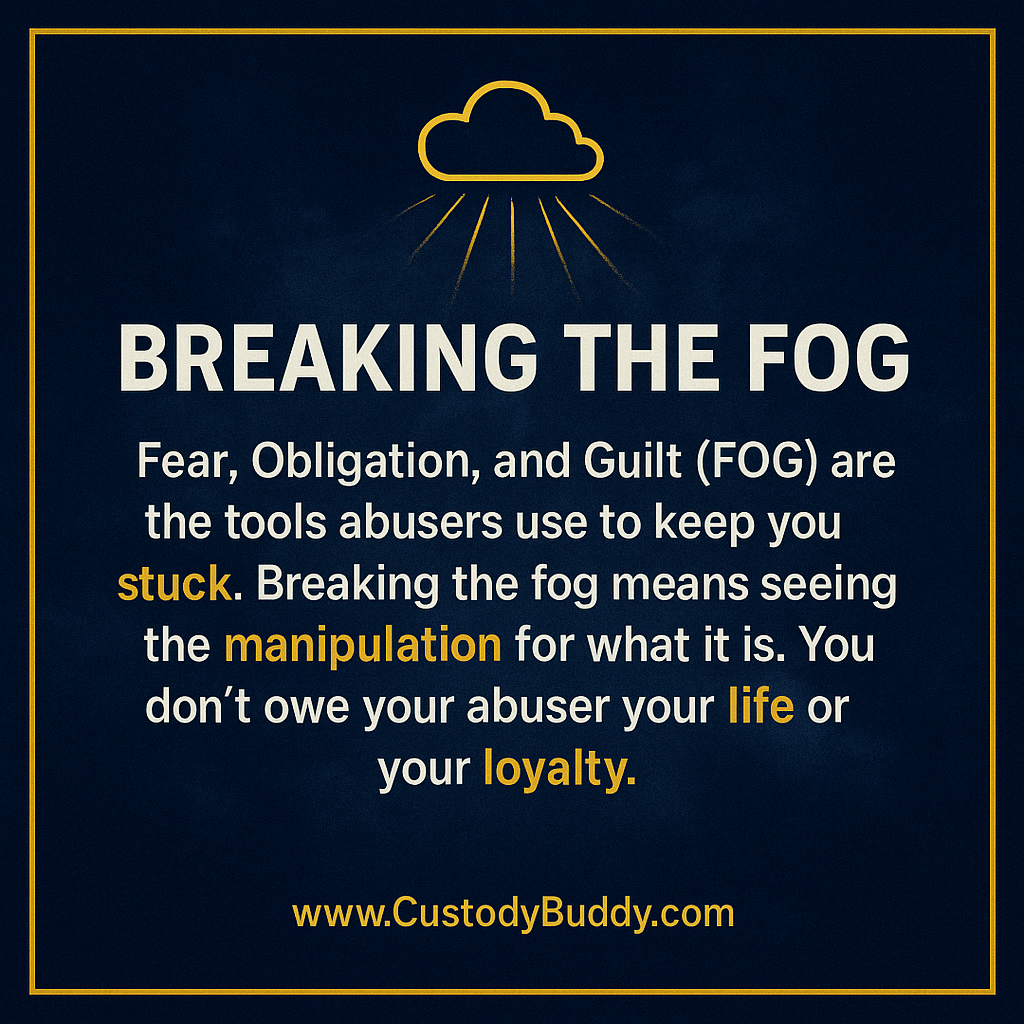
Breaking Free from FOG: Understanding and Overcoming Fear, Obligation, and Guilt in Abusive Relationships
If you’ve ever found yourself in a relationship where you’re walking on eggshells, saying “yes” when you want to say “no,” or apologizing like it’s your favorite hobby, chances are, you’ve been stuck in the FOG. No, not the kind that ruins your morning jog—FOG stands for Fear, Obligation, and Guilt. And let’s be real: it’s not nearly as mystical or romantic as it sounds. It’s a downright manipulative cocktail, shaken and stirred with emotional confusion and control tactics.
Breaking out of this FOG isn’t just about turning on the metaphorical headlights—it’s about truly understanding what’s going on, separating truth from gaslighting, and finding your way to emotional clarity.
What is FOG? And Why Is It So Sneaky?
FOG is a psychological power play. It keeps people stuck in abusive relationships by creating emotional confusion. The cycle of fear, obligation, and guilt can keep someone anchored to a person they’d rather run from faster than you can say “therapy, please.”
Let’s unpack this emotional suitcase, shall we?
Fear
- What it looks like: You’re terrified of your partner’s reactions. Saying the “wrong” thing leads to shouting, blaming, or silent treatments that could qualify as Olympic-level psychological warfare.
- Why it works: Abusers use fear as a control tool. They might not always raise their voice—sometimes it’s a look, a threat, or the knowledge that they’ll make your life miserable in subtle, strategic ways. Think “emotional chess,” but the only rule is that they always win.
Obligation
- What it looks like: Feeling like you “owe” someone your time, love, loyalty, or even your silence—even when they treat you like yesterday’s leftovers.
- The bait-and-switch: Abusers craft a narrative where you’re “selfish” if you prioritize your needs. They might remind you of all they’ve “done for you”… conveniently ignoring the part where they also made your life a stress smoothie.
Guilt
- What it looks like: You feel bad when you try to set boundaries. You feel like a bad partner, parent, or human—even when you’re just trying to take care of yourself.
- How it traps you: Guilt keeps you in a defensive loop. The abuser doesn’t even have to point fingers anymore. You do it to yourself. Hello, guilt spiral, our unwelcome houseguest.
The Emotional Tag-Team: How FOG Works Together
Each piece of FOG on its own is messy enough, but when they tag-team (which they often do), it’s like getting stuck in one of those escape rooms… minus the fun teamwork and celebratory pizza.
Here’s a not-so-fun fact: one moment you’re afraid to speak up, the next you’re guilt-ridden for thinking about leaving, and then you feel obligated to stay “just a little longer.” Cue the trap door—you’re emotionally stuck.
Examples from Real Life (AKA Human People, Not Just Psychology Textbooks)
- Your partner explodes when you spend time with friends. So, you cancel plans “to keep the peace.” (FEAR)
- They remind you how much they’ve sacrificed for you… like three months ago when they picked up dinner. (OBLIGATION)
- They cry and say, “You’re the only one who’s ever loved me,” when you set a basic boundary. (GUILT)
The result? You start second-guessing your damn-near-every move. Welcome to the FOG machine. Dry ice not included.
How to Spot FOG in the Wild (Or, You Know, Your Life)
Sometimes, identifying FOG starts with asking some brave, slightly uncomfortable questions.
Ask Yourself:
- Do I feel afraid to bring things up or “rock the boat”?
- Do I feel like I owe someone endless loyalty, despite how they treat me?
- Do I constantly feel bad or selfish for wanting space, peace, or personal goals?
If reading those made you say, “Yikes, a little too accurate,” take a breath. That’s awareness knocking. Let it in—it brought snacks and clarity.
Breaking Through the Fog (Cue the Empowerment Anthem)
Escaping FOG isn’t about being fearless—it’s about being informed, supported, and just gutsy enough to take the first step. Think of it as emotional windshield wipers. You don’t need to see the full road—just enough to move forward.
Acknowledge What You Feel
- Your emotions are not overreactions; they’re information. And you don’t need someone else’s permission to believe your own experience.
Set Brave, Beautiful Boundaries
- Boundaries aren’t walls—they’re life-saving fences with cute little “do not trespass” signs. Learn to say “no” without a guilt hangover.
Call in the Troops
- You don’t have to do it alone. Seek support from friends who get it, a therapist who’s trauma-informed, or a professional trained in family law and abuse dynamics.
Cultivate Self-Compassion Like It’s Your New Side Hustle
- Healing isn’t linear. You’ll stumble and second-guess yourself. That’s okay. Forgive yourself often and early.
Continue Your Family Law Journey
Recognizing FOG is an important first step, but breaking free from manipulation often requires more than self-awareness alone—it requires a safety plan, clear boundaries, and professional support tailored to your unique situation.
Whether you’re navigating custody arrangements, documenting patterns of control, or simply seeking a confidential space to talk through your options, the resources below can help you move from understanding to action.
Pro tip: You are not too sensitive. You are not too needy. You’ve just been under an emotional weather system that’s finally clearing.
You deserve safety. You deserve peace. And you sure as heck deserve a relationship that doesn’t require a decoder ring to navigate.
Legal Note: This article offers coaching and emotional guidance. It is not a substitute for legal advice. For legal support, please consult a family law professional.
Recommended Resources
These books have helped many parents navigate similar challenges. As an Amazon Associate, I earn from qualifying purchases.
Divorce Poison: How to Protect Your Family from Bad Mouthed Kids
by Richard Warshak
This book provides insights into the psychological impact of high-conflict parenting and strategies to foster healthy relationships with children amidst parental discord.
The Co-Parents’ Handbook: Raising Healthy Children with a Narcissistic Ex
by Sarah L. S. O’Connor
It offers practical advice for managing the challenges of co-parenting with a narcissistic ex-partner while prioritizing the well-being of children.
Recovering from Emotional Abuse: A Guide for Survivors
by Lily Gardner
This book focuses on trauma recovery and emotional healing, which is essential for parents navigating high-conflict situations with former partners.