
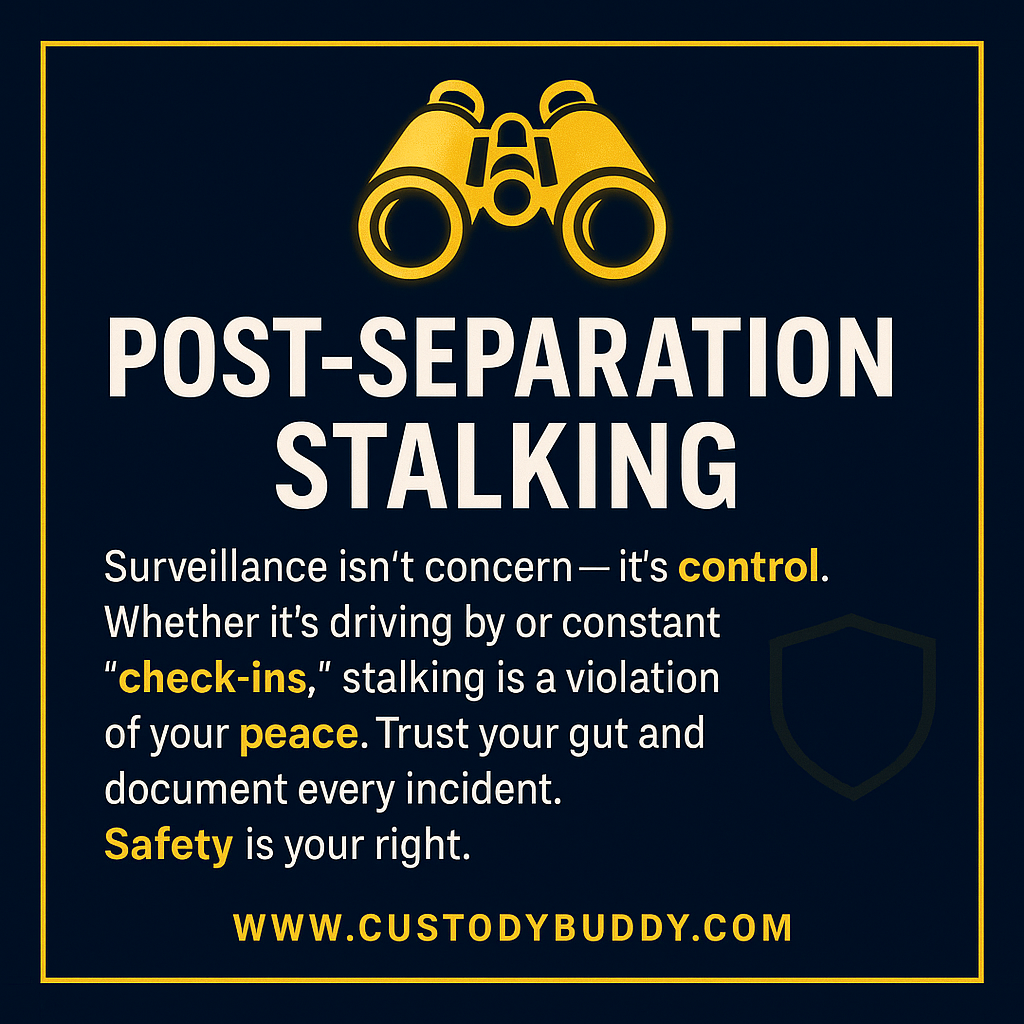
Post-Separation Stalking: Surveillance Isn’t Concern—It’s Control
Recognizing the Creep Behind the Curtain
You’ve slammed the relationship door, and just when you finally exhale… BAM! There they are, again—“accidentally” parked outside your new gym. Or “liking” that photo from three years ago—on your cousin’s profile. Hint: That’s not concern. That’s creeping.
Stalking, especially post-breakup, isn’t about love or closure. It’s about control, plain and simple (but like, aggressively controlling—not-the-remote kind).
So let’s pull back the curtain, call control what it is, and take back your peace. You’ve got things to do—like heal, thrive, binge-watch guilt-free, and reclaim your sparkle.
Understanding Post-Separation Stalking
1.1 What Is Stalking, Really?
Stalking isn’t just someone lurking in the bushes with binoculars and bad intentions. It includes a wide range of behaviors that are:
- Unwanted (obviously)
- Repeated (as in, “Why are you here AGAIN?”)
- Threatening to your safety, peace, or sanity
Legally, stalking can include following, harassing, threatening, or monitoring another person. But just because something doesn’t land in court (yet) doesn’t mean it isn’t serious.
And let’s be real—just because someone calls it “worrying” doesn’t mean they get a free pass to track your life like the FBI with a Google alert.
1.2 Common Forms of Post-Separation Stalking
Welcome to the greatest hits of ex-based surveillance (sarcasm, obviously):
- Physical surveillance: Popping up at your work, your yoga class, or the dog park they suddenly love.
- Digital snooping: Monitoring your socials, creating fake accounts, blowing up your texts like it’s 2007 AIM.
- Third-party fishing: Asking friends what you’re up to—like they’re building a spreadsheet of your whereabouts.
If it feels more like CSI than catching up, trust that it’s not okay.
The Psychological Impact of Stalking
2.1 Anxiety, Fear, and Other Unwelcome Guests
Dealing with a stalker doesn’t just mess with your calendar—it messes with your head.
Here’s what victims often deal with:
- High-key anxiety
- A loss of freedom and autonomy (because someone’s always “watching”)
- Emotional exhaustion that makes even grocery shopping feel like a mission
- Isolation and self-doubt—“Am I overreacting?” (Spoiler: Nope.)
Your gut reaction is your body throwing a full-on emergency flare in the air. Don’t ignore it.
2.2 No, It’s Not “Because They Care”
Time to bust out the confetti: stalking isn’t romantic.
Say it with feeling: Unwanted attention is not affection. Repeat until free of second-guessing.
There’s a whole Netflix genre built on the myth that obsession = love. (Yes, “You,” we’re looking at you.) But IRL, constant monitoring isn’t endearing—it’s unnerving.
Control wears a lot of masks. But love? Love respects boundaries, not stomps all over them in steel-toed boots.
Trusting Your Gut
3.1 Your Intuition Is Basically a Superpower
If you feel icky, weird, watched, or exhausted trying to justify someone’s behavior—ding, ding, ding! That’s your intuition ringing the alarm bells.
Some behaviors are so subtle they fly under the radar. But your nervous system knows. Listen.
This is less about “proof” and more about self-trust. You’re not a detective. You’re a human who deserves peace.
3.2 Raising Your Voice and Owning Your Space
Step one in taking back your power? Honor your discomfort. Even if no one else sees it.
Things you ARE allowed to do:
- Set boundaries so clear they’re practically on neon signs
- Talk to supportive friends or a therapist—gaslighting doesn’t survive in sunlight
- Say “No” without a TED Talk of explanations
Nothing gives anyone the right to microwave themselves back into your life uninvited.
The Importance of Documentation
4.1 Why Writing Stuff Down Is Basically Jedi-Level Self-Defense
Here’s the deal: documentation matters. Why? Because when the “he said, she said” spiral starts, a smartly kept log cuts through the chaos.
What to jot down:
- Date and time of every unwanted contact
- The medium (text, creepy parking lot visit, drone attack—kidding, we hope)
- Witnesses or screenshots to back it up
Think of it like building a solid digital (or paper) wall between you and Crazytown.
Continue Your Family Law Journey
You’ve just recognized that surveillance isn’t concern—it’s control, and now it’s time to turn that awareness into action with solid documentation and protective steps.
These resources are tailored to help you meticulously record incidents, enforce boundaries for your safety and your kids’ stability, and navigate co-parenting without the constant intrusion.
- Stalking Protection Orders Guide
- How to Document Harassment Effectively
- Setting Co-Parenting Boundaries
Legal Disclaimer
This content is offered as coaching-based support and empowerment—it does not constitute legal advice. For legal guidance specific to your situation, consult a licensed attorney familiar with your state laws.
Recommended Resources
These books have helped many parents navigate similar challenges. As an Amazon Associate, I earn from qualifying purchases.
The Co-Parenting Handbook: Raising Well-Adjusted and Resilient Kids
by Karen Bonnell and Kristin Little
This book provides practical strategies for co-parenting effectively while navigating high-conflict relationships.
High-Conflict People in Legal Disputes
by Bill Eddy
It offers insights into managing interactions with high-conflict individuals in legal contexts, which is essential for parents facing narcissistic ex-partners.
The Emotionally Abusive Relationship: How to Stop Being Abused and How to Stop Abusing
by Beverly Engel
This book addresses emotional dynamics that can arise in high-conflict separations and provides guidance on healing and recovery.